Ronan Harrington: The Go-To Keynote Speaker for High-Growth Teams Under Pressure


If you are organising a leadership off-site or company-wide event and your brief sounds anything like this: "our people are exhausted, we have big targets to hit, and we're going through a lot of change" — this article is written for you.
That brief lands in my inbox more than any other. And it makes sense. The organisations I work with, including Deloitte, EY, PwC, KPMG, Meta, L'Oréal, Sky, Aviva, IHG, Siemens Energy, Kimberly-Clark, HM Treasury, and the University of Oxford, are not struggling because their people lack talent or ambition.
They are struggling because the model of performance most organisations still run on was not built for the world we are now living in.
This article explains what I do, why it works, and what your teams will take away.
The Brief I Keep Getting
A McKinsey Health Institute survey of nearly 15,000 workers across 15 countries found that on average one in four employees globally report burnout symptoms. More striking for a senior audience: workers who feel higher levels of burnout are six times more likely to say they intend to leave their jobs within the next three to six months. That is not a wellbeing issue. That is a retention and continuity crisis.
And it reaches all the way to the top. Deloitte's Well-Being at Work Survey of 3,150 C-suite executives, managers, and employees found that 75% of the C-suite are seriously considering quitting for a job that would better support their wellbeing. The most senior people in your organisation are not immune. In many cases they are the most at risk.
The traditional response, more motivation, more resilience training, more wellness apps, does not solve this. It papers over it. What organisations need is a fundamental shift in how they think about performance itself.
Why the Old Model Is Failing
Most corporate performance culture is still built on endurance. The unspoken assumption is that the highest performers are the ones who push hardest for longest. In a knowledge work environment shaped by always-on technology, this creates what I call the mowing the lawn trap: grinding through an endless task list, keeping the anxiety at bay, while the work that actually moves the needle never gets done.
As productivity thinkers from Oliver Burkeman to Cal Newport have shown, you cannot outrun an inbox. Every email you send generates the potential for another reply. The never-ending to-do list is not a temporary problem to be solved. It is the permanent condition of modern work. Endurance culture treats it as something to be conquered. Resilience culture treats it as something to be managed intelligently.
The same McKinsey Health Institute research found a persistent 22% gap between how employers and employees perceive mental health and wellbeing at work, with employers consistently rating their own workplaces more favourably than the people inside them. Most wellbeing programmes are solving the problem leaders think they have, not the one their people are actually experiencing.
The Resilient High-Performance Method™
Over the past five years, working in collaboration with Deloitte, PwC, EY, and KPMG, I have developed the Resilient High-Performance Method™: a practical framework that gives leaders and teams a clear operating model for delivering at their best under sustained pressure and through significant change.
It is built on a deceptively simple insight: resilience is not about becoming tougher. It is about becoming smarter. Specifically, it is about learning to oscillate.
Nick Petrie, one of the leading researchers on burnout at the Center for Creative Leadership, found that high performers with a low risk of burnout deliberately structure their work around pairs of polar opposites: deep work and shallow work, focused solo time and collaborative time, exertion and recovery. They do not grind continuously. They move intentionally between intensity and renewal, and over time that oscillation expands their capacity rather than depletes it.
This is the operating model I bring into organisations. Not as a theory, but as a set of practical shifts in how teams structure their days, their meetings, their priorities, and their recovery.
The Questions That Change the Room
One of the most powerful things I do in a keynote is run leaders through a set of diagnostic questions drawn from a Harvard Business Review framework on sustainable senior performance. These are not warm-up questions. They are the ones people have been avoiding.
A few that tend to land hardest:
"What percentage of my calendar would I delete if I rebuilt this role from scratch?"
"Where is the work overengineered?" (Where am I adding effort that nobody asked for and nobody notices?)
"Where is my superpower space, and what percentage of my time am I genuinely spending there?"
"On a scale of 1 to 10, how much do I personally care about the core problem my role exists to solve?"
"What expectations do I need to reset?"
"The person I need to be to make this work is..."
Harvard Business Review frames this kind of audit as essential for senior leaders whose roles have drifted significantly from what they were originally designed to deliver. The drift is rarely visible until someone asks the right questions in the right room.
Energy Is the Asset, Not Time
One of the central reframes in my keynote is this: time is not your most valuable performance asset. Energy is.
Research published in Harvard Business Review argues that sustainable high performance depends not on managing hours but on managing physical, emotional, mental, and purposeful energy. When organisations design work around time, they get compliance. When they design it around energy, they get performance.
In practice this means building team rhythms that respect cognitive load, protecting deep work windows from meeting creep, and creating genuine stop points in the working day that allow for recovery rather than residue.
Psychological Safety Is Not Soft. It Is the Engine of Performance.
In my keynotes, I often ask: "What if the single greatest accelerator of your firm's performance is emotional, not transactional?"
Google's Project Aristotle study examined over 250 team-level variables to identify what distinguishes high-performing teams from low-performing ones. The single most important factor was psychological safety. Teams with high psychological safety were rated as effective twice as often by management. This research, built on the foundational work of Harvard Business School professor Amy Edmondson, has since become one of the most cited findings in organisational performance.
Psychological safety is not about being nice or lowering standards. It is about building a culture of trust where people can speak up, flag problems, and share ideas without fear of judgement. In high-pressure environments, that translates directly to catching problems early before they escalate, more accurate risk assessments, and stronger collaboration under pressure. That is operational excellence.
What Change Fatigue Actually Is
Many of the briefs I receive mention change fatigue specifically. Leaders notice their teams are resistant, disengaged, or going through the motions during transformation programmes. They often frame it as a communication problem or a culture problem.
In most cases it is neither. It is a capacity problem.
When people are already operating at the edge of their bandwidth, any additional demand, however well communicated or strategically sound, lands as a threat rather than an opportunity. The neurological reality is that chronic stress narrows cognitive function, reduces creative thinking, and impairs the kind of complex judgement that change programmes depend on.
McKinsey's research on organisational health identifies psychological safety and clear role clarity as among the highest-leverage factors in change readiness. Without them, even the best-designed transformation stalls.
My keynote addresses this directly by giving teams a shared language and a practical toolkit for navigating change without burning out in the process.
What Organisations Take Away
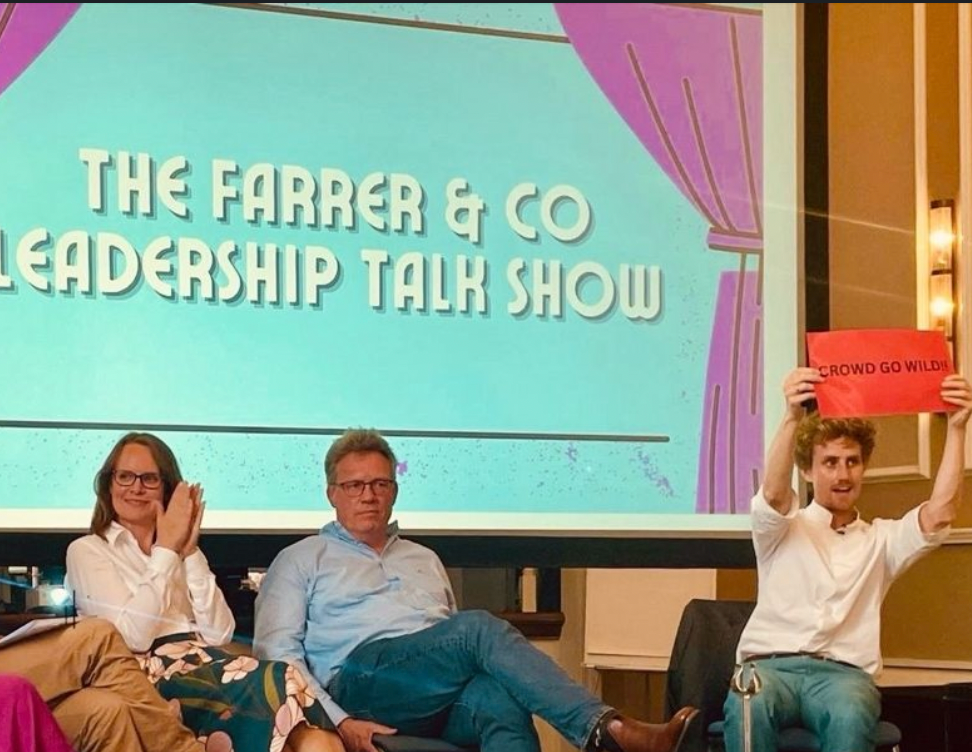
The Resilient High-Performance Method™ is designed to be cascaded. Organisations including Ogier and Farrer and Co have rolled it out from junior team members to senior partners so that the entire organisation is operating from the same high-performance playbook.
The reason this works is that shared language changes culture at scale. When everyone from a junior hire to a managing director understands what oscillation means, what superpower space means, and what the difference between endurance and resilience looks like in practice, behavioural norms shift without requiring top-down enforcement.
That is the difference between a keynote that provides a temporary lift and one that leaves a structural residue.
Why This Keynote, Why Now
If your senior people are running on fumes and you have a big year ahead of you, the worst thing you can do is tell them to try harder. The second worst thing is to send them to a wellness session that treats burnout as a personal failing.
What works is giving them a new operating model, one that is intellectually rigorous, practically actionable, and delivered by someone who has not just studied resilience but has had to rebuild from the ground up.
I have worked with some of the world's most demanding organisations, from the Big Four accounting firms to Meta, L'Oréal, Sky, HM Treasury, and Oxford University, to help their senior people perform at their best precisely when the pressure is highest.
Your team needs more than armour. They need a battle plan.
If you are planning a leadership event and want your people to leave with a framework they will actually use, get in touch.

Comments